
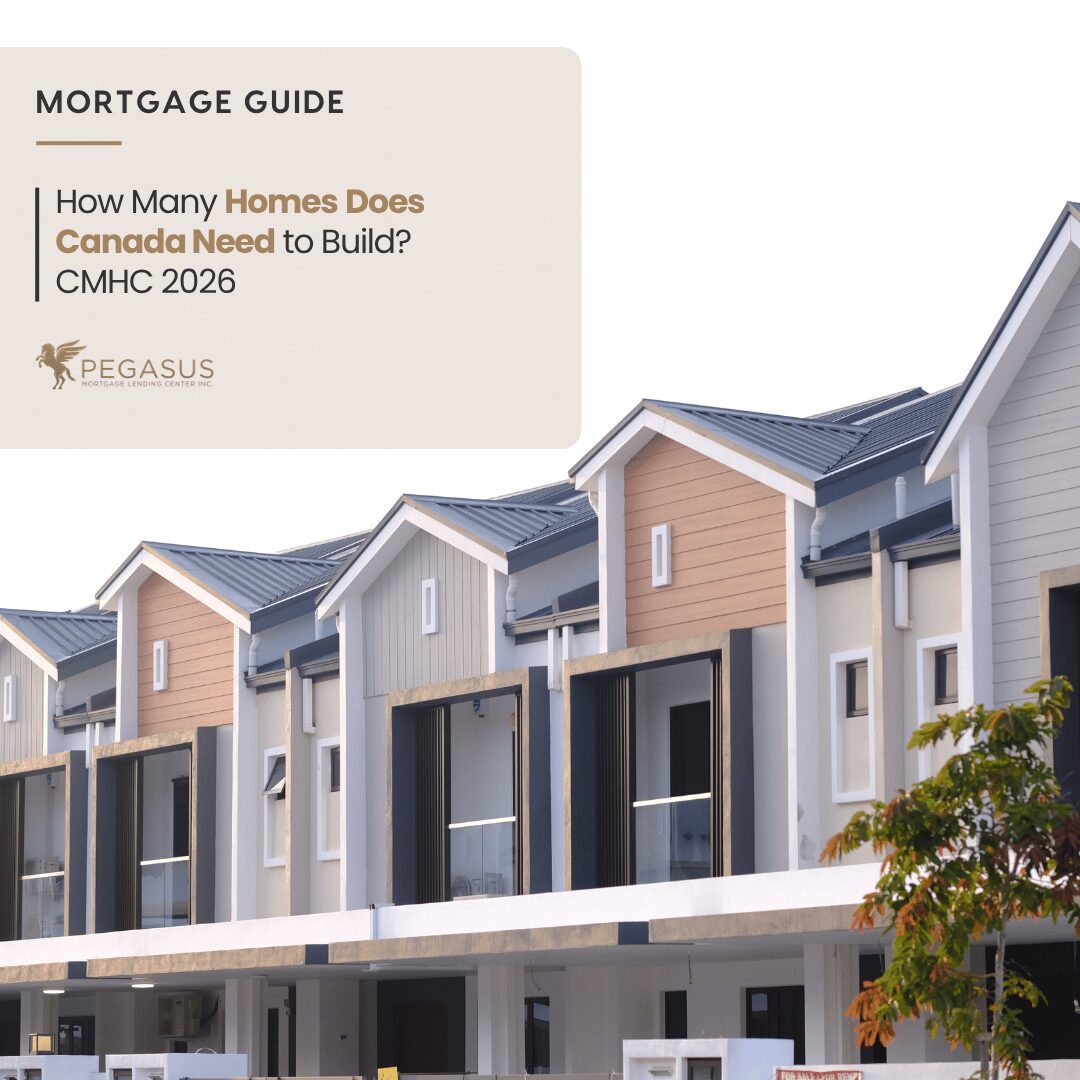
- Canada needs to build between 417,000 and 469,000 new homes every year through 2036 to restore housing affordability to pre-pandemic (2019) levels, according to CMHC's Fall 2026 Housing Supply Report released on September 10, 2026.
- At the current pace, Canada is on track to build only about 231,000 homes annually — roughly half of what the country needs.
- That leaves an annual supply gap of 187,000 to 238,000 homes on top of what is already being built.
- The gap has narrowed in Toronto and Calgary in 2026, remained stable in Vancouver, and widened in Ottawa and Montreal.
- Purpose-built rental construction now accounts for roughly 60% of new housing starts, compared with less than 20% a decade ago.
— Why the numbers behind the headlines matter for buyers
If you have been shopping for a home in Canada — or just watching the news — you have probably heard that the country is not building enough homes. In September 2026, the Canada Mortgage and Housing Corporation (CMHC) put a number on the problem: the country needs to build roughly twice as many homes each year as it currently is.
That kind of headline can feel like bad news for anyone hoping to buy soon. But it is not the whole story. The supply gap is a long-term policy horizon, not a forecast for next month's prices. What it changes is how a thoughtful buyer plans — the questions to ask, the tools to use, and the timing decisions that can typically save the most money.
Before we get into what the number means for your mortgage, it helps to see it clearly. That is where working with an independent broker can save real time and money.
— Quick start: pick your path
Not every reader is in the same spot. Pick the path that matches you.
Start with the numbers. Use Pegasus's mortgage affordability calculator to see what your income can support, then read the first-time home buyer guide for the basics: down payment, closing costs, and the federal stress test.
The supply gap has less to do with your renewal than with new buyers, but the rate environment it hints at is worth understanding. Skip ahead to the section on prices and rates.
Read the common mistakes section carefully. Waiting can make sense — but it works best when it is a plan, not a reaction to a headline.
— What CMHC's 417,000-to-469,000 number actually means
That gap — 187,000 to 238,000 homes per year on top of what is already being built — is what makes headlines. But the numbers deserve more than a headline.
"Pre-pandemic affordability" is CMHC's benchmark, not a promise. It refers to the roughly 2019 relationship between home prices and household incomes. In plain English: a household earning a typical income could afford a typical home more easily then than now. CMHC's target is to bring that relationship back within a decade — by 2036.
The report also flags a shift in what is actually being built. Purpose-built rental construction — apartment buildings owned by a landlord and rented out — now accounts for roughly 60% of new starts nationally. A decade ago, that share was under 20%. That matters, because a first-time buyer looking to own a home is competing for a smaller slice of new supply than the total 231,000 number suggests.
Two words to keep in mind here. Housing starts are the number of new homes that break ground each year — the official measure used by CMHC and Statistics Canada. Supply gap is the difference between the homes CMHC estimates the country needs and what is actually being built. When you see either phrase in the news, it is usually this Fall 2026 report they are referring to. For definitions of related terms, see our mortgage terms glossary.
— Where the gap is widening — and where it is closing
The national number tells one story. Your city tells another.
CMHC's Fall 2026 report updated its city-level estimates against 2025. Some markets improved. Others got worse. Here is the direction of the change:
- Toronto — the supply gap narrowed. More homes are being built relative to demand than a year ago.
- Calgary — the gap narrowed significantly. Record housing construction has closed the shortfall faster than any other major market.
- Vancouver — the gap remained stable. Softer resale prices helped, but higher expected population growth and slower projected starts offset the gain.
- Ottawa — the gap widened. Fewer homes are being built than the region needs.
- Montreal — the gap widened. Similar dynamic to Ottawa.
Why does this matter to a buyer? Because national headlines can push you toward decisions that do not fit your local reality. A buyer in Calgary is negotiating in a market where new supply is arriving at a record pace. A buyer in Ottawa is in a market where the shortfall is getting worse. Same national policy, very different day-to-day experience.
There is also a shift in what is being built almost everywhere. In Vancouver alone, purpose-built rental apartments now make up roughly 60% of starts, up from less than 20% a decade ago. That means new construction is increasingly aimed at renters, not at people looking to own. If you are watching cranes go up in your neighbourhood, many of those new units may be rental — not resale.
None of this is a forecast of your city's prices next month. Local supply changes typically take one to three years to fully show up in resale prices, appraisals, and rate spreads. But it does shape the questions worth asking your broker — including what today's current rate details look like in your specific market.
— What a supply gap can typically do to home prices and mortgage rates
When there are fewer homes for sale than people looking to buy, prices tend to hold up better than they otherwise would — even when interest rates rise. That is the textbook version. In real life, the effect is uneven, delayed, and varies enormously by city and property type.
Here is what a persistent supply gap can typically influence for a Canadian buyer:
Appraisal values. Lenders rely on appraisals to decide how much of a home's price they will finance. In tight markets, appraisals often come in closer to the asking price. In markets where construction is catching up (like Calgary), appraisals can lag rising asking prices.
Rate strategy. Persistent under-building is one of many signals lenders and the Bank of Canada watch when setting rates. It does not by itself decide where rates go — but it is part of the picture when choosing between a fixed and a variable mortgage.
Insured vs conventional financing. A high-ratio (less than 20% down payment) mortgage requires default insurance from CMHC, Sagen, or Canada Guaranty. A supply gap does not change the rules of insurance — but it can affect the price you pay for the home the insurance is calculated against.
"The supply gap is a slow signal, not a fast one," says Razi Khan, Founder, CEO and Mortgage Broker at Pegasus. "It should shape how you think about a five-year plan, not what you do this weekend."
Any specific rate, appraisal ratio, or price figure quoted in this article or elsewhere is illustrative only — not a forecast. Real numbers depend on your file, your city, and the lender you end up with.
— Step-by-step: how to plan a mortgage when supply is tight
A supply-tight market rewards buyers who plan in steps rather than react to headlines. Here is a practical roadmap.
-
1
Run your affordability number honestly. Before falling in love with a listing, know the ceiling. Pegasus's affordability calculator uses the federal stress test rule: you must qualify at the greater of contract rate plus 2% or 5.25%. Whichever is higher becomes your qualifying rate.
-
2
Check your down payment scenario. Different down payment sizes unlock different products. Use the down payment calculator to see how 5%, 10%, or 20% changes your monthly payment, your insurance premium, and the total interest you pay over the life of the loan.
-
3
Lock a rate hold with a pre-approval. A pre-approval is not a full mortgage approval — it is a lender's estimate of what you can borrow and a rate hold, typically for 90 to 120 days. If rates rise while you are shopping, your hold protects you. If they fall, you can usually re-quote.
-
4
Know your renewal window. If you are not a new buyer, the same supply-and-rate picture affects your renewal. Start comparing offers six months before your term ends. Your current lender is not the only one who will bid for your renewal.
-
5
Build a fixed vs variable game plan. Fixed rates give payment certainty. Variable rates move with the Bank of Canada. Neither is always right — the choice depends on your income stability, your term length, and how much movement you can absorb without stress.
The point of the roadmap is not to rush. It is to keep small choices moving forward while the larger question — buy now, wait, renew — sorts itself out on your own timeline.
— Common mistakes buyers make in a supply-tight market
The Fall 2026 report is generating strong reader reactions. A few of them can quietly cost you money:
- Waiting for a "crash" the data does not support. CMHC's projection is a slow, decade-long affordability gap — not a signal that prices are about to collapse.
- Skipping the pre-approval rate hold. A 90 to 120 day rate hold is one of the cheapest forms of protection you can get. It costs nothing.
- Assuming all new construction is for sale. With roughly 60% of new starts being purpose-built rental, the 231,000 homes per year figure does not translate to 231,000 homes coming up for sale.
- Over-stretching on offers in a tight micro-market. Local supply shortages tempt buyers to bid beyond their qualifying number. The federal stress test — the greater of contract rate plus 2% or 5.25% — exists for a reason.
- Forgetting Ottawa and Montreal are different from Toronto. Local supply-gap direction shapes local negotiating power. Use it.
- Skipping the broker step at renewal. Your current lender counts on you not shopping. See more in our full FAQ.
— Frequently asked questions
How many new homes does Canada actually need to build each year?
Is the housing shortage in Canada getting better or worse in 2026?
Will home prices go down in Canada because of the supply gap?
Should I buy a home now or wait for prices to drop?
Which Canadian city has the worst housing shortage right now?
How does the housing supply gap affect my mortgage rate?
What does CMHC mean by "pre-pandemic affordability"?
Is Canada realistically going to hit the 2036 target?
Ready to see your real number?
Skip the headlines. Get a personalized pre-approval — free, no pressure.
Get your instant pre-approval certificate
About the author
Razi Khan
Founder, CEO & Licensed Mortgage Broker · Pegasus Mortgage Lending · Toronto, Ontario · FSRA Lic # 11479
Razi Khan is the Founder, CEO, and a licensed Mortgage Broker at Pegasus Mortgage Lending Center Inc., based in Toronto. With over 20 years of experience in the Canadian mortgage industry, Razi has personally guided more than 3,000 clients through some of the most complex and high-stakes financial decisions of their lives — from first-time purchases in the GTA to refinancing strategies, alternative lending solutions, and cross-border mortgages for Canadians buying in the United States.
Razi founded Pegasus in October 2008, launching the brokerage at the height of a global financial crisis. He works across the full spectrum of borrower profiles, with particular expertise in complex files including self-employed borrowers, credit-challenged clients, and investors building multi-property portfolios.
Learn more about Razi Khan →Sources & References
- Canada Mortgage and Housing Corporation (CMHC) — Fall 2026 Housing Supply Report. cmhc-schl.gc.ca
- CMHC News Release — "Slowing home construction threatens recent affordability gains" (September 10, 2026). newswire.ca
- Global News — "Want 2019 housing affordability? Canada must double building rate: CMHC". globalnews.ca
- Office of the Superintendent of Financial Institutions (OSFI) — Guideline B-20: Residential Mortgage Underwriting Practices and Procedures. osfi-bsif.gc.ca
- CMHC — In-House Podcast: Fall 2026 Housing Supply Report. cmhc-schl.gc.ca